 |
|
|
"For a Stick o'Fire" short revisits to a Caribbean countryside |
|
|
What, Where, When,
Why and How
|
About the book
“For a stick o’ fire” is a book based on true accounts and is written for an audience from 6 to 80 years and above.
The book briefly describes, through a miscellaneous collection of verses, various aspects of life as they took place in the small community of people living in the Dutch Cul-de-sac valley during the period between 1950 and 1970. This was an era just before St. Maarten began evolving into the modern and progressive society that it is today. The entire island was then standing on the threshold of modernization and progress.
The title stems from the old St. Maarten saying: “Ah just come for a stick o’ fire”. This is an expression older folks used when they came for a short visit. It comes from a time when a person who wanted to light the fireplace or coal pot, would go to a neighbour and ask for a stick of fire and hurry back home before it extinguished. The analogy with the book is that the stories are short and concise, and by reading (one of) them, the nineteen fifties and sixties are, in a sense, shortly revisited.
Some may refer to the book as telling ‘old time stories’ of days gone by. But “For a stick o’ fire” is not written for the sake of nostalgia.
The main goal of the book is to offer a perspective to the (young) readers. One that enables them to see the differences between then and now and the major changes that have taken place. It attempts to arouse an interest in cultural-historical education by taking the recent past of a small section of St.Maarten that has changed ‘beyond recognition’, as point of departure. In other words: the goal is to inform, educate, entertain, inspire and involve.
The short narratives of people (anonymous), events, locations and situations show the reader how resilient the people of this small community in Marigothill, Reward and St. Peter's were, in the face of hard times, and when recovering from natures clouts. Their resourcefulness, creativity, inventiveness and sense of humour in a time and place when and where scarcity was the norm, is evident. Although modern terms such as, urban mining, recycling, sustainability etc. were not used, they were being practiced nonetheless, out of necessity. Their technologies can in no way be compared with those of today. Yet they are worthy of the term all the same as their knowledge and methods helped them to solve problems, when applied. In conclusion one can say that the tangible as well as intangible cultural heritage is the fabric of “For a stick o’ fire”.
With this ‘fabric’ the author has formed a mosaic consisting of twelve chapters with items that might appear to be trivial when seen in today's light, but where of vital importance in days gone by.
About the format and illustrations
"Rhythm and rhyme": attractive to the ear and retainable by the memory
The content of the book is presented in verse. Research has shown that rhyme and rhythm enhances the listening skills and stimulates the memory of children as well as adults, helping them to focus. In addition, rhyme helps to improve language and aids the cognitive development of children.
“One sketch is worth a thousand words”
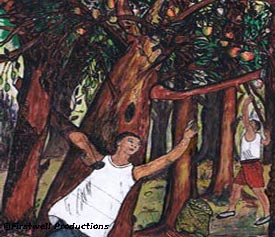
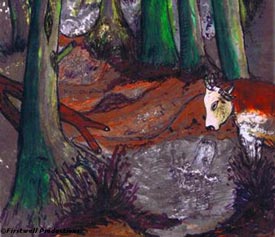
The illustrations are presented in Retro-style sketches in order to emphasize the fact that the book is about the 1950’s and 1960’s. Guideline was the question: How would the illustrations look if “For a stick o’ fire” was written in 1950? It is apparent that they would not be dazzling results of ‘Photoshop’ and other renowned modern techniques, but most likely black and white, hand drawn, concise and maybe with a cartoon-like twist. The illustrations may be the only elements in the book that make the difference between then and now completely clear to a young audience…as they might find them less pleasing than a modern-day rendition. Seen in this light, the illustrations may offer a learning moment. As the book is meant for the entire family, efforts have been made to diversify the sketches and maje them appealing to various age-groups; some simpliified for the very young, and others less sketchy. However the sketches are only there to support the text.
About the author
“Caelum non animum, mutant, qui trans mare currunt”
The above mentioned Latin phrase translates as:”Those who hurry across the sea, change the sky [above them] but not their soul.” In turn, a modern paraphrase to this expression would be: “You can take the girl out of the island, but you can’t take the island out of the girl”
Drs. Mulberry Egstorf-Pantophlet spent her childhood days in the community that is being described in this book, and has witnessed how certain elements of the culture and way of life that used to be, have given way to progress. However, the motivation for writing this book is not based on nostalgia or romanticism, but rather on the need felt to share my knowledge of the past and to document it so that it would to be accessible to everyone, in particular to the youth. In order to do so in a proper manner, months have been spent doing research, prior to writing the book. Finding at least two sources (written or oral) regarding a statement before using it as material for the book was essential.
The author’s background in Special Education and Science & Technology Studies has helped to determine the topics and subjects of the book. At the same time the author realizes that a different writer would most likely have made others choices.
Presently, a cultural-historical perspective is considered invaluable for young people all over the world. Various countries have official canons in place that serve as a basis for historical-cultural curriculum in schools. Much thought is given to composing regional and local canons that incorporate important landmarks in time and space, the ‘movers and shakers’ of a community, meaningful events etc.
St. Maarten, as a young country, may wish to compile such a canon in the future. It is the humble hope of the author that when that time comes, “For a stick o’ Fire” may be a modest contribution, and that together with other unofficial narratives and accounts, form a valuable body of knowledge from which an official canon can be drawn.
“Culture is Self” Lasana M. Sekou
“The history of a nation, or island, is marked by dates, facts, and people” Mr.Ing.R.Richardson
“The tendency to dig in the past is now enormous and to go on a journey of discovery to do something with it is even bigger. Novels or short stories that we will be reading in different times could give us a look into the emotions, thinking and behaviours of the people of
St. Maarten” Mr. Quito Nicolaas
|